The Bird You Leave Alone: Restraint as a Real Shooting Skill
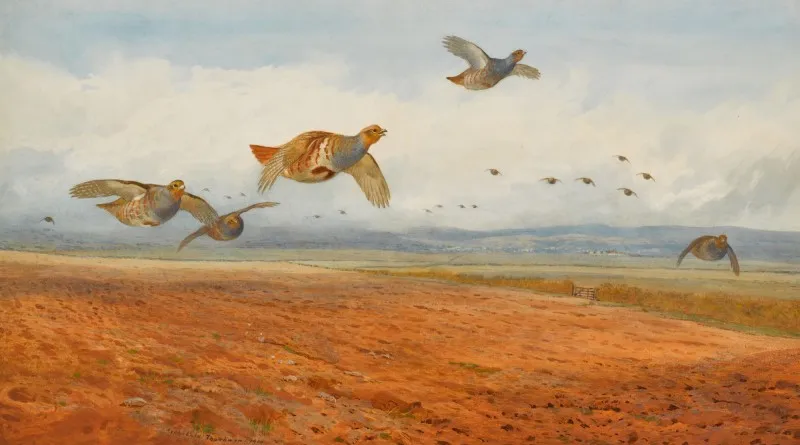
Photo: Archibald Thorburn, Public domain, via Wikimedia Commons
The shot you don't take
There is a moment on a walked-up day when a covey gets up and the whole line seems to tighten. The easy thing is to swing through the middle and let the cartridge do the talking. The better thing, sometimes, is to watch. Restraint is not the same as passivity. It is fieldcraft with the safety still on: reading the ground, the wind and the day, then deciding that the best contribution you can make is to leave the birds alone.
That sounds soft to some ears. It is not. Anyone who has watched a shoot try to rebuild a grey partridge population knows that a covey of eight in November is not a target. It is next spring's breeding stock, next season's sport and a fair chunk of the keeper's patience. Pulling the trigger is the simple part. Knowing when not to is the skill that takes longer to learn.
Reading the covey, not just the bird
Grey partridges are a good teacher. They rise tight, they head into wind and they rarely give you the clean, forgiving crosser that a released pheasant will. If a covey gets up into a stiff south-westerly, it will climb and curl, and the birds at the back are often the ones that get pricked by a gun who is chasing the flock rather than picking a line. A single bird, taken cleanly and marked down, is worth more than a scattered volley into a covey that leaves two runners in the kale.
Wind direction matters here more than most people admit. Birds will naturally drift and climb into the breeze, so a covey rising downwind is already changing shape. Watch the first bird, not the tenth. If the covey is breaking and you have not picked your bird before the gun reaches your shoulder, you are probably already late. The unshot bird is often the one you never had a safe, clean line on in the first place.
When the bag is already enough
There is a particular sort of pressure on the last drive of the day. The bag is met, the light is going and the guns are still loaded. Someone always wants one more. Sometimes that is fine. Often it is not. A self-imposed limit is not a suggestion from the shooting syndicate; it is a decision you make before you leave the motor. If you have said two birds for the pot, stop at two. If the flightline has died and the pigeons are flaring at forty-five yards, stop shooting at them.
Pigeon decoying is a good example. The sport is in the reading of the flightline and the building of the hide, not in banging away at long, speculative birds because the magnet is still spinning. A pigeon that is pricked at range will often sail into the next parish, and you will never see it again. The bird you leave alone is a bird that might come back to the decoys on a better day, and a bird that does not give the landowner another reason to think shooters are only interested in volume.
Landowner maths
Permission is not a piece of paper. It is a relationship, and it is renewed every time someone sees you behave well. The keeper who watches you pass a low hen pheasant and then pick a clean cock bird over the dog will remember it. The farmer who finds a pricked fox or a runner in the hedge will remember that too. Restraint is part of the access argument. It is not just about the future of the shoot; it is about being the sort of person who gets asked back.
There is also the plain practical matter of retrieval. A bird that is left unshot does not need to be found. A bird that is shot badly does. If the cover is thick, the light is poor and the dog is already busy, the sensible shot is often the one you do not take. That is not a lack of nerve. It is knowing the difference between a chance and a good chance.
A working rule set
None of this needs to become a lecture. A few simple habits cover most of it. Decide your bag before the drive, not during it. Pick a single bird rather than the middle of a covey. Do not shoot into a strong wind if you cannot see where a runner will land. Leave the long, low-percentage bird for someone else or for another day. And if the day has already given you enough, enjoy the walk back with the dog rather than trying to squeeze the last drop out of it.
The unshot bird is not a missed opportunity. It is a decision, and a fairly grown-up one. Good shooting is not only about what falls. It is about what you leave behind: a covey that will breed, a landowner who will say yes again, and a day that finished cleanly rather than with a search party in the dark.