Rimfire Reality Check: Where the .22LR Still Makes Sense
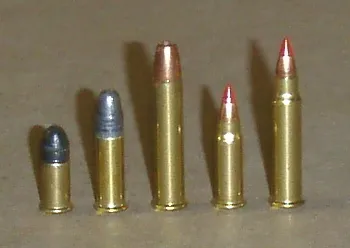
Photo: Arthurrh, CC BY-SA 3.0, via Wikimedia Commons
The .22LR has a habit of being overlooked. It is not fast, it is not flat-shooting, and it will never win an argument in a gun shop full of glossy centrefire rifles. Yet in a UK field kit, a good rimfire rifle still does more quiet, useful work than plenty of fancier kit. If you are building a practical cabinet for rabbits, squirrels, close-range dispatch and cheap practice, the little rimfire deserves a serious look in 2026.
The case for a boring cartridge
Boring is underrated. The .22LR is cheap enough to shoot often, mild enough to shoot well, and accurate enough to teach you things that a heavier rifle can hide. It is not a long-range cartridge and it is not a foxing round, but that is not the point. The point is that it lets you put in the hours.
For a UK shooter, that matters. Practice is not just trigger time; it is learning to read wind, judge range, use a rest properly and take a clean shot at sensible distances. A rimfire lets you do all of that without burning through a premium centrefire budget. It also makes a superb companion rifle when you are checking traps, walking a permission or dealing with a small pest problem that does not need a cannon.
Cheap practice is a real skill builder
A .22LR is at its best when it is used often. A box of ammunition costs far less than most centrefire fodder, and the low recoil means you can concentrate on the basics instead of bracing for a thump. That makes it ideal for new shooters under proper supervision, and just as useful for experienced shooters who want to stay sharp between outings.
There is also the quiet factor. A moderated .22LR is not silent, whatever the old boys in the clubhouse say, but it is far less disruptive than a centrefire. That can matter on permissions near houses, livestock or busy footpaths. It does not remove the need for safety or permission, but it does make the rimfire easier to live with in the real British countryside.
Ammo: pick a diet and stick to it
Rimfire rifles can be fussy. Two boxes of the same nominal ammunition can shoot differently, and changing brands mid-season can shift your point of impact enough to matter. Find a round that suits your rifle, your moderator and your intended use, then buy a decent batch and test it properly.
For general rabbit and squirrel control, standard-velocity lead round-nose ammunition is a sensible starting point. Subsonic rounds are quieter through a moderator and often very accurate at close range, but they drop more and need a known zero. High-velocity hollow-points can work well where expansion and a slightly flatter trajectory help, but they are not a licence to stretch the range. Test everything on paper before you point it at live quarry.
Zeroing and fieldcraft
A 50-yard zero is a common and practical choice for a .22LR field rifle. It keeps the trajectory manageable for typical rabbit and squirrel ranges without pretending the cartridge is something it is not. Learn your holdover at 60, 70 and maybe 80 yards, but do not kid yourself that a rimfire is a 150-yard tool. Wind pushes a little bullet around far more than most people expect.
Use a proper rest when zeroing, take your time and keep notes. A small notebook or a phone note with ammunition type, zero distance and moderator fitted is worth more than guesswork. When you move to the field, use available cover, pick stable shooting positions and pass up the shots that feel marginal. The .22LR rewards fieldcraft because it forces you to get closer.
Safety, permissions and the limits
A .22LR rifle is a firearm in the UK and must be held on a valid firearm certificate with the correct conditions. Check your certificate, your land and your local rules before heading out. A moderator is not a substitute for safe backstops, and a quiet round is not a reason to skip basic safety.
Ricochet is a real consideration with rimfire. Flat ground, hard surfaces and stones are not your friends. Always know what is behind your target and shoot into a safe backstop. On permissions, keep to the areas you have been given permission to use and respect the landowner's boundaries. The fact that a .22LR is modest does not make it harmless.
Humane dispatch: close, calm, correct
One of the most practical roles for a .22LR is humane dispatch at close range. That might mean a trapped rabbit, a wounded bird or livestock that needs a quick end under the correct conditions. It is not a job to improvise. Know the anatomy, use a safe and appropriate distance, and make sure the shot is clear and uncontested. If you are not confident, do not take the shot; get experienced help.
This is where the rimfire's mild report and manageable recoil can be an advantage, but only when the shooter is calm and the situation is controlled. A .22LR is not a magic wand. It is a precise tool that demands precision from the person holding it.
Where it does not belong
Be honest about the limits. The .22LR is not a fox cartridge, not a deer cartridge and not a windy-field long-range round. It is also not the right choice for every dispatch situation, particularly where angles, distance or animal size make a centrefire more appropriate. Trying to make a rimfire do a bigger job is how good tools get a bad name.
It is also worth remembering that cheap ammunition does not mean careless shooting. Every round deserves a safe backstop and a clear reason. The .22LR earns its place through discipline, not through being treated as a toy.
Final verdict
The .22LR remains one of the most genuinely useful cartridges in a UK field kit. It is cheap to feed, pleasant to shoot, quiet enough to be practical and accurate enough to teach real field skills. It will not replace a centrefire for the bigger jobs, but it does not need to. In 2026, a good rimfire rifle with a sensible moderator, a tested zero and a box of ammunition you trust is still a very hard combination to beat for everyday countryside work.