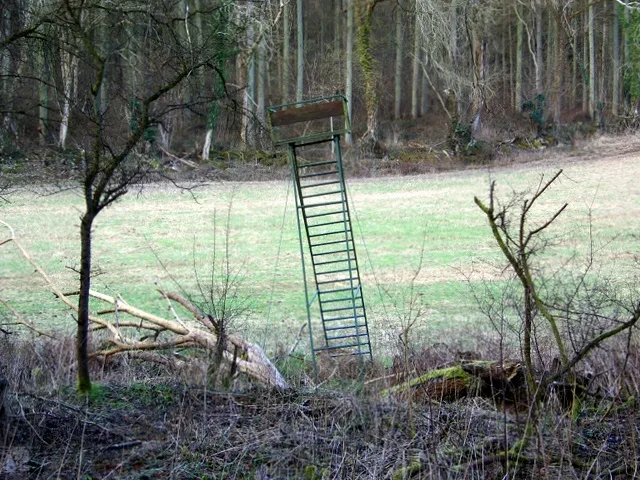
Trust the Ladder, Not the Habit: Auditing a High Seat in the Cold Half of the Year
Photo: E. B. Stephens, CC BY-SA 2.0, via Wikimedia Commons
High seats breed familiarity. You build one, use it for a season, then start treating it like a fencepost — something that was sound last time and will therefore be sound now. That works until it doesn't. In the cold half of the year, when fingers are numb, light is poor and the ground is slick, a high seat needs to be treated as a piece of safety equipment first and a shooting platform second. Not a catalogue item to admire. A tool to audit.
Start with what actually holds you up
Before you think about the view, think about the load path. Every high seat has one: the ground, the anchors, the uprights, the platform, the seat, then you. If any part of that chain is a guess, stop guessing.
On a fixed seat, check the tree or posts first. Is the tree still alive and sound? Has it grown around a strap or rubbed one thin? Has the ground moved, softened or eroded around the base? A seat that was rock-solid in dry September can feel very different after weeks of rain and a bit of wind. Push and pull the uprights properly — not a polite nudge, but a firm test at the height where you will actually climb. If there is movement at the base, there will be more at the top.
On a portable seat, the same rule applies but faster. Open it fully, check every pin, locking collar and pivot. Look for bent legs, ovalised holes and straps that have stiffened or frayed. If a strap has been stored wet, assume it has suffered until you have inspected it closely. Replace rather than repair when it comes to load-bearing webbing. A bit of baler twine is not a fix.
The harness is not optional kit
A high seat without a proper harness is just a raised place to fall from. That sounds blunt because it is meant to. If you use a fixed seat regularly, a fall-arrest harness and a suitable anchor point should be part of the routine, not a thing you meant to sort out. Follow the manufacturer's instructions for the seat and the harness, and do not mix systems unless you know they are compatible.
Check the harness before it goes on: webbing for cuts, stitching for wear, buckles for cracks, and the anchor point for corrosion or distortion. Then check how you will actually connect. Is the anchor above your head where it should be? Is the lanyard long enough to let you sit and shoot but short enough to do its job? Is there anything sharp or hot nearby — a rusty edge, a heater, a bit of wire — that could damage the webbing in use? A harness that lives in the back of a truck and gets dragged through mud is not inspection-ready. Clean it, dry it and store it properly.
Corrosion, welds and the quiet cracks
Metal fails quietly. Paint hides rust. A weld can look fine until you put a torch on it. Take a light with you — not just the lamp on your rifle — and look properly at the joints, welds and bolt holes. Surface rust is one thing; flaking metal, deep pitting and hairline cracks are another. Pay attention to the parts that flex: the seat frame, the shooting rail mounts and the ladder brackets.
Bolts are the usual suspects. Check that they are present, tight and not working loose. If a seat uses nyloc nuts or locking washers, make sure they are still doing their job. A missing bolt is obvious in daylight and invisible in the dark, which is exactly why the check belongs in your routine rather than your memory.
Ladders, gates and the last metre
Most incidents happen at the edges — getting on, getting off, or leaning where you shouldn't. Check the ladder rungs for rot, ice, mud and loose fixings. If the ladder is wooden, probe it. If it is metal, check the welds and the feet. Make sure the bottom of the ladder is on firm ground and not sitting on a slope that will shift under your weight.
Then think about the last metre. Can you get from the ladder to the platform without unclipping your harness at the wrong moment? Is the gate or opening clear of branches, wire or anything that will catch a coat or a sling? In winter, a seat can be fine and the access still be rubbish. Clear the steps, trim the snagging branches and make the route boring. Boring is good.
The shooting rail and the field of view
The rail is there to steady a shot, not to encourage you to lean out like a gargoyle. Check that it is secure, that the padding or rest is not loose, and that it does not restrict the safe arc of fire. A high seat should let you shoot within a sensible arc without standing up, twisting awkwardly or muzzling the ladder. If you have to contort yourself, the seat is in the wrong place or you are using it wrongly.
Also check what has changed since last time. A hedge that was low may now block the shot. A branch may have grown into your line. A footpath may have shifted closer, or a new fence may have appeared. Safety includes knowing where your bullet will go if it misses or passes through. A high seat does not remove that responsibility; it raises the stakes.
A pre-climb check that actually gets done
Keep it short enough to repeat in the dark:
- Torch the base, anchors and ladder feet. Look for movement, rot and erosion.
- Check straps, pins, bolts and locking mechanisms. Replace damaged webbing.
- Inspect the harness, lanyard and anchor point. Fit it before you climb.
- Look at welds, joints and rail mounts with a light. Watch for cracks and deep rust.
- Clear the ladder and the platform. Remove ice, mud and snagging branches.
- Test the seat and rail with your weight before you settle in.
- Confirm your safe arc of fire and what lies beyond it.
If any check fails, do not negotiate with it. A wobbly seat does not become safe because you are in a hurry. A frayed strap does not improve with a knot. The sensible answer is often to leave it for daylight, fix it properly, or stalk in from the ground instead. A high seat is a convenience, not a necessity. Walking away from a doubtful one is not a wasted morning; it is the morning going right.
When the ground is the better option
Some days the seat is the wrong tool anyway. Hard frost, strong wind, wet snow or a suspect ladder all point the same way: get your feet on the ground and use the cover you have. Stalking in from below is slower, but it keeps you honest. You see more of the ground, you are less committed to one position, and you are not relying on a structure you have not been able to check properly. There is no shame in leaving the seat alone. There is plenty of shame in climbing it because it was there.